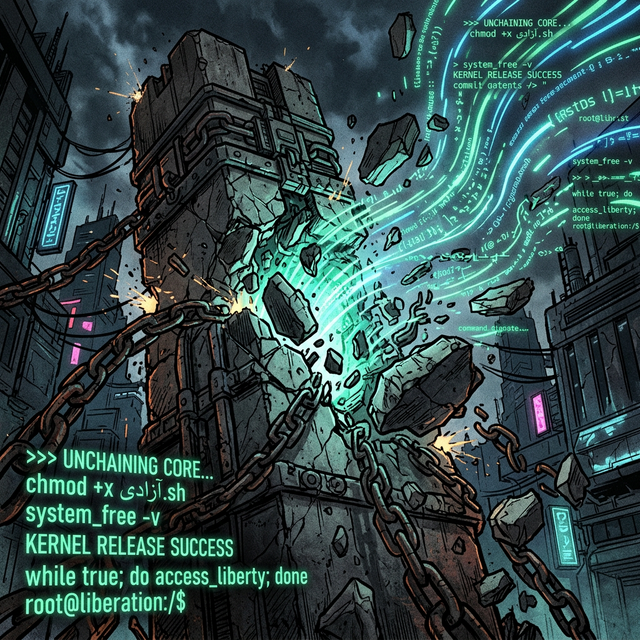
 Sebastian Schkudlara

We keep pretending that wrapping an LLM in a thin API layer and telling it “don’t touch the filesystem” constitutes real security.
It doesn’t.
The API Sandbox is Theater
Here’s a confession from our own commit logs on switchAILocal: we were auto-injecting --include-directories=/ into the Gemini CLI, effectively hardcoding root filesystem access just to make the tool functional.
Think about what that means. We punched a hole clean through our own sandbox before it was even fully built — not because we were being reckless, but because application-layer sandboxing is fundamentally incompatible with operational utility.
The moment you need the agent to actually do something useful — read a file, invoke a CLI tool, traverse a directory — you have to relax your constraints. Every relaxation is a breach. Relying on brittle CLI flags to contain a non-deterministic reasoning engine is pure security theater.
The Environment Is Escalating
We are not dealing with a static threat model. Transformers are already executing programs natively, with inference times dropping exponentially year over year. Terminal emulators are mutating into rich, hyperlink-aware, multi-modal environments. The attack surface is expanding faster than our security posture is adapting.
You cannot contain a system that reasons about its environment by asking it nicely via a system prompt or a restricted API endpoint.
When the machine writes the code, compiles it, and executes it in milliseconds, your application-level checks are invisible to the actual execution flow. The agent isn’t constrained by your API wrapper. It’s constrained only by what the OS itself permits.
Kernel-Level Isolation or Nothing
It is time to stop treating local AI agents as benign productivity helpers. They are untrusted execution environments. Full stop.
The correct answer is mandatory kernel-level isolation:
- Hard filesystem namespaces that prevent the agent from traversing outside its designated working root, enforced by the OS, not by a Python wrapper.
- Network stack constraints applied directly to the agent’s process, using architectures like libp2p Circuit Relay v2 with real NAT traversal (the same approach used in
traylinx-stargate) — not just port-blocking rules that a spawned subprocess can ignore. - Ephemeral process trees with automatic kill switches at the kernel level if the agent attempts to escape its designated resource bounds.
Anything less than treating your local AI agent as a hostile tenant on your own hardware is not a security posture. It’s an optimistic hope.
The good news? The tooling to do this correctly already exists. The will to implement it is what’s been missing.
 Markdown is the New Assembly: Why LLM Pipelines Need Structural Compilers